
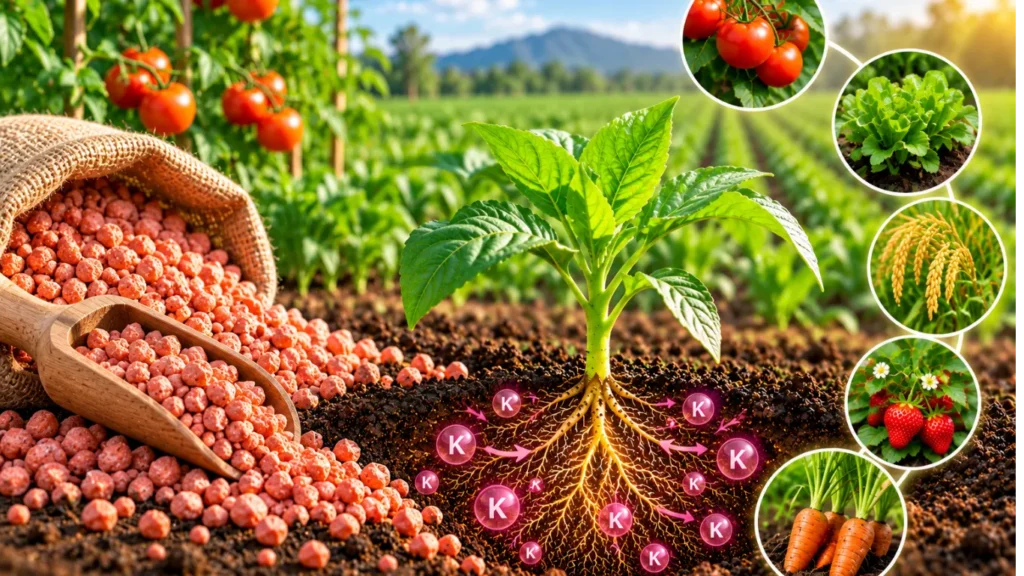
Potassium is one of the essential nutrients required by plants for healthy growth and development. It plays an important role in several plant processes, including water regulation, enzyme activity, nutrient movement, and overall crop development. When soil does not provide enough available potassium, a suitable potassium fertilizer may be included in the crop nutrition program.
Potassium fertilizers are available in different formulations and concentrations. The appropriate product depends on the crop, soil condition, existing nutrient levels, growth stage, and fertilizer formulation.
In this guide, we will explain what potassium fertilizer is, its benefits, common types, uses, application methods, and important factors to consider before applying it.
1. What Is Potassium Fertilizer?
Potassium fertilizer is an agricultural fertilizer used to supply potassium to plants. Potassium is commonly represented by the letter K and is one of the three primary plant nutrients, along with nitrogen and phosphorus.
Potassium supports several important plant functions. It is involved in water regulation, enzyme activation, nutrient transport, and plant development.
Potassium fertilizers can be used for:
- Vegetable crops
- Fruit crops
- Field crops
- Horticultural crops
- Flowering plants
- Plantation crops
- Nursery plants
- Ornamental plants
The exact potassium concentration varies between products, so growers should always check the fertilizer label before application.
2. Why Is Potassium Important for Plants?
Potassium is important for normal plant growth and development. Unlike nitrogen and phosphorus, potassium is not primarily incorporated into plant structures, but it plays important regulatory roles inside the plant.
Potassium contributes to:
- Water regulation
- Enzyme activity
- Nutrient movement
- Plant metabolic processes
- Overall plant development
- Crop-quality management
Adequate potassium availability can therefore be an important part of balanced plant nutrition.
However, plants require a balanced supply of several nutrients. Potassium should not be applied simply because it is considered an important nutrient; soil and crop requirements should be evaluated first.
3. Benefits of Potassium Fertilizer
When potassium is required and an appropriate fertilizer is applied correctly, potassium fertilizer can support several aspects of crop nutrition.
Key benefits include:
Supports water regulation: Potassium plays an important role in the movement and regulation of water within plants.
Supports enzyme activity: Potassium is involved in the activation of many plant enzymes.
Supports nutrient movement: Adequate potassium contributes to normal nutrient transport within plants.
Supports plant development: Potassium is important for healthy plant growth and development.
Supports crop quality: Adequate potassium nutrition can be important during crop development and production.
Complements balanced nutrition: Potassium fertilizer can be included in a broader nutrient-management program alongside other essential nutrients.
The actual response depends on soil potassium levels, crop requirements, fertilizer source, application rate, and environmental conditions.
4. Types of Potassium Fertilizers
Different potassium fertilizers are available for agricultural applications.
| Type | Main Characteristic | Common Application |
|---|---|---|
| Potassium Chloride | High potassium concentration | Field and agricultural crops |
| Potassium Sulphate | Potassium with sulphur | Crops requiring potassium and sulphur |
| Potassium Nitrate | Potassium with nitrogen | Fertigation and crop nutrition |
| Liquid Potassium | Liquid formulation | Foliar or soil application depending on product |
| Specialty Potassium Products | Product-specific formulation | Horticulture and crop nutrition |
The best fertilizer depends on soil conditions, crop requirements, nutrient needs, and the specific product formulation.
5. Potassium Fertilizer for Different Crops
Different crops can have different potassium requirements.
Vegetable Crops
Vegetables require balanced nutrition throughout their growth cycle. Potassium may be particularly important during stages associated with crop development and production.
Fruit Crops
Fruit crops require appropriate potassium nutrition during different stages of development. A suitable potassium fertilizer can be included in the crop nutrition program when soil and crop requirements indicate a need.
Field Crops
For field crops, potassium fertilizer application should ideally be based on soil testing, crop requirements, expected yield, and local agricultural recommendations.
Flowering Plants
Suitable potassium products can be included in plant nutrition programs for flowering plants when potassium is required.
6. How to Apply Potassium Fertilizer
The application method depends on the fertilizer formulation and crop.
Common methods include:
- Soil application
- Band application
- Broadcasting
- Fertigation
- Foliar application for suitable products
- Root-zone application
Before application, growers should check:
- Potassium concentration
- Recommended dosage
- Crop suitability
- Application method
- Growth stage
- Soil nutrient status
- Compatibility with other fertilizers
Avoid applying excessive potassium. Nutrient balance is important because very high levels of one nutrient can affect the availability or uptake of other nutrients.
7. Best Time to Apply Potassium Fertilizer
Application timing depends on crop type, soil condition, fertilizer formulation, and growth stage.
Potassium may be applied before planting, during crop establishment, through the growing season, or during specific development stages depending on crop requirements.
Important factors include:
- Crop type
- Soil potassium level
- Plant growth stage
- Irrigation method
- Fertilizer formulation
- Weather conditions
- Recommended application schedule
Soil testing can help growers determine whether additional potassium is required.
8. Potassium Fertilizer vs NPK Fertilizer
Potassium fertilizer and NPK fertilizer have different nutrient compositions.
| Feature | Potassium Fertilizer | NPK Fertilizer |
|---|---|---|
| Main nutrient | Potassium | Nitrogen, phosphorus and potassium |
| Primary purpose | Supplies potassium | Provides multiple primary nutrients |
| Selection | Based on potassium requirement | Based on overall nutrient requirement |
| Application | Crop and product specific | Crop and formulation specific |
| Best use | When potassium supplementation is required | Balanced primary nutrient management |
The choice between a potassium fertilizer and an NPK fertilizer should be based on soil test results, crop requirements, and the existing nutrient-management program.
9. Frequently Asked Questions About Potassium Fertilizer
What is potassium fertilizer?
Potassium fertilizer is an agricultural fertilizer used to supply potassium, an essential plant nutrient.
What does potassium do for plants?
Potassium supports water regulation, enzyme activity, nutrient movement, and several important plant processes.
Can potassium fertilizer be used for vegetables?
Yes, suitable potassium fertilizers can be used for vegetable crops according to crop requirements and product instructions.
Can potassium fertilizer improve fruit development?
Adequate potassium nutrition is important for crop development and quality. However, application should be based on the specific crop and its nutrient requirements.
How often should potassium fertilizer be applied?
There is no universal application schedule. Frequency depends on crop type, soil potassium levels, fertilizer formulation, and recommended dosage.
Can potassium fertilizer be mixed with other fertilizers?
Some potassium fertilizers can be used with other fertilizers, while compatibility varies by product. Always check the manufacturer’s instructions before mixing.
Need Help Choosing the Right Potassium Fertilizer?
Choosing a suitable potassium fertilizer depends on your crop, soil condition, potassium requirement, and application method.
Chayan Fertilizers provides agricultural input solutions for farmers, growers, nurseries, and agricultural businesses looking for suitable crop nutrition products.
Before purchasing a potassium fertilizer, check its nutrient concentration, recommended dosage, crop suitability, and application instructions.
Visit Chayan Fertilizers to explore agricultural products and learn more about crop nutrition solutions.
For product information and crop-specific requirements, contact the Chayan Fertilizers team.
Conclusion
Potassium is an essential plant nutrient that supports several important physiological processes. Potassium fertilizer can be an important component of a balanced crop nutrition program when soil and crop requirements indicate a need.
The right fertilizer should be selected according to soil conditions, crop type, growth stage, nutrient requirements, and product formulation.
Chayan Fertilizers provides agricultural products designed for different crop nutrition and plant-management requirements.