
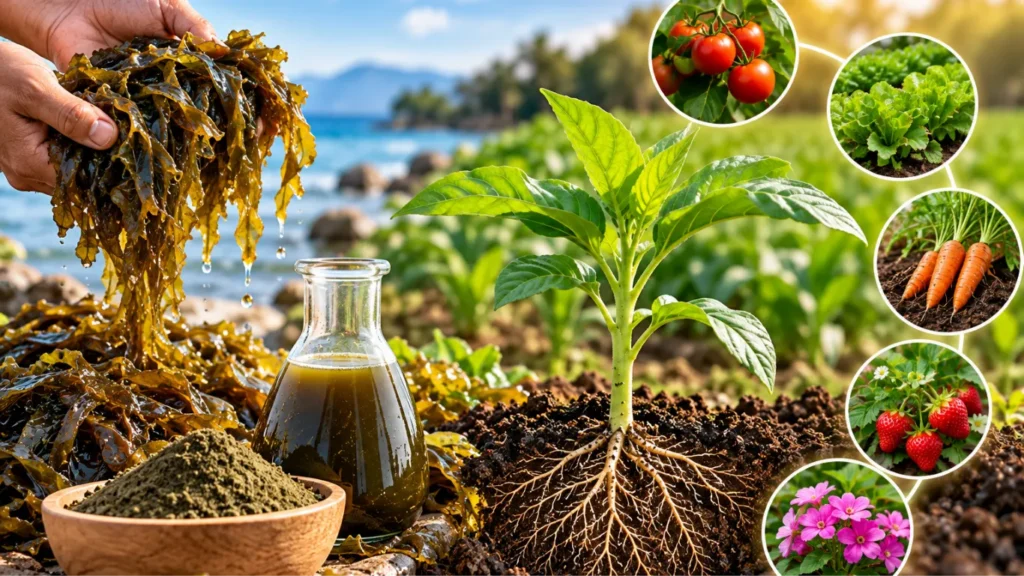
Seaweed fertilizer has become a popular agricultural input for farmers, gardeners, nurseries, and growers looking to support healthy plant development. Seaweed-based products are generally made from marine algae and may contain naturally occurring compounds, minerals, and other substances that can be useful in plant and crop-management programs.
Depending on the formulation, seaweed fertilizer can be applied to different types of crops, plants, vegetables, fruits, flowers, and horticultural crops. It is often used as part of an integrated crop nutrition program rather than as a complete replacement for essential plant nutrients.
In this guide, we will explain what seaweed fertilizer is, how it works, its potential benefits, different types, application methods, suitable crops, and important factors to consider before using it.
1. What Is Seaweed Fertilizer?
Seaweed fertilizer is an agricultural or horticultural product made from processed seaweed or marine algae. The raw seaweed is processed into different formulations such as liquid extracts, concentrates, powders, or other agricultural products.
Seaweed contains naturally occurring compounds and minerals, and processed seaweed products may be used to support plant growth and crop-management practices.
Depending on the product, seaweed fertilizer may contain compounds such as naturally occurring minerals, organic matter, and plant-supporting substances.
Seaweed-based products can be used in:
- Vegetable crops
- Fruit crops
- Flowering plants
- Ornamental plants
- Nursery plants
- Horticultural crops
- Field crops
- Home gardens
The composition of each product can be different, so growers should always check the product label before application.
2. How Does Seaweed Fertilizer Work?
Seaweed fertilizer is generally used as a plant-support product rather than simply as a conventional source of major nutrients.
Depending on its formulation, seaweed extract may contain naturally occurring compounds that can support various plant processes. It can be applied to soil, around the root zone, or as a foliar application when the product label recommends it.
Seaweed-based products may be incorporated into crop-management programs to support:
- Plant development
- Root-zone conditions
- Vegetative growth
- Flowering and fruit development
- Plant response to environmental conditions
- Overall crop-management practices
The exact effect depends on the seaweed source, extraction method, concentration, crop, application rate, and growing conditions.
3. Benefits of Seaweed Fertilizer for Plants
Seaweed fertilizer is widely used because of its potential role in supporting plant growth and crop development.
When used correctly, suitable seaweed products can complement regular crop nutrition and plant-care practices.
Key potential benefits include:
Supports plant growth: Seaweed-based products can be incorporated into plant-growth management programs.
Supports root development: Appropriate applications may help create favorable conditions around the root zone.
Supports flowering and fruit development: Seaweed products may be included during important crop growth stages when recommended.
Provides naturally occurring compounds: Seaweed contains various naturally occurring substances that may be retained or concentrated during processing.
Supports crop-management programs: Seaweed fertilizer can complement other nutrient and crop-care practices.
Suitable for different crops: Seaweed products are available in formulations for vegetables, fruits, flowers, horticultural plants, and field crops.
However, seaweed fertilizer should not be treated as a universal solution. Crop requirements, soil fertility, product formulation, and recommended dosage should always be considered.
4. Types of Seaweed Fertilizer
Seaweed fertilizer is available in different forms. The best option depends on the crop, application method, and manufacturer’s recommendations.
| Type | Form | Common Application |
|---|---|---|
| Liquid Seaweed Extract | Liquid concentrate | Foliar spray or soil application |
| Seaweed Fertilizer | Liquid or concentrated formulation | Crops and horticulture |
| Seaweed Powder | Dry powder | Soil or product-specific applications |
| Seaweed-Based Plant Booster | Liquid or other formulation | Plant growth programs |
| Seaweed + Nutrient Formulation | Combined formulation | Crop nutrition and growth management |
Liquid seaweed products are commonly used because they can be diluted according to the manufacturer’s recommended dosage and applied through suitable methods.
Always read the product label to understand the correct dilution, application method, and frequency.
5. Seaweed Fertilizer vs Traditional Fertilizer
Seaweed fertilizer and conventional fertilizers can have different roles in crop management.
Traditional fertilizers are generally formulated to provide specific nutrients such as nitrogen, phosphorus, and potassium. Seaweed products are often used as plant-support inputs and may contain naturally occurring compounds from marine algae.
| Feature | Seaweed Fertilizer | Traditional Fertilizer |
|---|---|---|
| Main source | Marine algae/seaweed | Mineral or manufactured nutrient sources |
| Primary role | Plant-growth and crop-support applications | Direct nutrient supply |
| Form | Liquid, powder, concentrate | Granules, liquids, powders |
| Application | Soil or foliar depending on product | Soil, foliar or fertigation depending on product |
| Nutrient content | Depends on formulation | Usually specified nutrient concentrations |
| Use | Often complements crop nutrition | Main nutrient-management input |
Seaweed fertilizer and conventional fertilizers are not necessarily alternatives. Depending on the crop and product compatibility, seaweed products may be incorporated into a broader crop-management program.
6. How to Use Seaweed Fertilizer
The correct application method depends on the product formulation. Liquid seaweed fertilizers are commonly diluted with water according to the manufacturer’s instructions.
Before applying the product, growers should carefully check:
- Recommended dosage
- Dilution ratio
- Application method
- Crop suitability
- Application frequency
- Storage instructions
- Compatibility with other agricultural products
Common application methods include:
Foliar Application:
A diluted seaweed product may be sprayed directly onto plant foliage when the product is approved for foliar use.
Soil Application:
Some formulations can be applied to soil or around the plant root zone.
Irrigation Application:
Certain liquid formulations may be suitable for application through irrigation systems when specifically recommended by the manufacturer.
Never assume that every seaweed fertilizer can be used through every application method. Follow the product-specific instructions.
7. Best Time to Apply Seaweed Fertilizer
The appropriate application time depends on the crop and product formulation.
Seaweed fertilizer may be used during important plant-development stages such as early growth, vegetative development, flowering, or fruit development when recommended for the specific product.
Factors affecting application timing include:
- Crop type
- Plant growth stage
- Soil condition
- Weather
- Irrigation practices
- Product concentration
- Application method
- Manufacturer recommendations
For foliar applications, growers may need to consider weather conditions and avoid unsuitable environmental conditions that could reduce application effectiveness.
A crop-specific application schedule is generally more appropriate than using the same schedule for every plant.
8. Seaweed Fertilizer for Different Crops
Different crops have different nutritional and growth requirements. Seaweed fertilizer can be included in crop-management programs when the product is appropriate for the crop.
Vegetable Crops
Seaweed-based products can be used in vegetable production as part of plant-growth and crop-management programs. Application should follow the recommended crop stage and dosage.
Fruit Crops
Fruit crops may require different nutritional support during vegetative growth, flowering, fruit setting, and fruit development. Suitable seaweed products can be incorporated into these crop-management stages when recommended.
Flowering Plants
Seaweed fertilizer can be used for suitable flowering and ornamental plants to support plant-care programs. Product instructions should be followed according to the specific plant.
Nursery Plants
Nurseries can use appropriate seaweed-based products as part of plant-growth and root-zone management when the product is suitable for nursery applications.
Field Crops
For commercial field crops, seaweed fertilizer should be selected based on crop requirements, product formulation, soil conditions, and recommended agricultural practices.
9. Frequently Asked Questions About Seaweed Fertilizer
What is seaweed fertilizer?
Seaweed fertilizer is an agricultural or horticultural product made from processed seaweed or marine algae. It is commonly used as part of plant-growth and crop-management programs.
Is seaweed fertilizer good for plants?
Suitable seaweed fertilizer can support plant-growth and crop-management programs when used correctly. Its effectiveness depends on the formulation, crop, dosage, application method, and growing conditions.
Can seaweed fertilizer be used for vegetables?
Yes. Suitable seaweed products can be used for vegetable crops when the product is recommended for the crop and applied according to the manufacturer’s instructions.
Can seaweed fertilizer be used for fruit plants?
Yes, appropriate seaweed products may be used for fruit crops as part of an integrated crop-management program.
Can seaweed fertilizer be applied to leaves?
Some liquid seaweed products are suitable for foliar application. Always check the product label before spraying leaves.
How often should seaweed fertilizer be applied?
There is no universal application frequency. It depends on the product formulation, crop, growth stage, dosage, and manufacturer’s recommendations.
Can seaweed fertilizer replace NPK fertilizer?
Seaweed fertilizer should not automatically be considered a replacement for essential nutrient fertilizers. Its role depends on the formulation and crop requirements and is often complementary to a broader nutrition program.
Need Help Choosing the Right Seaweed Fertilizer?
Choosing the right seaweed fertilizer depends on your crop, plant growth stage, application method, and product formulation.
Chayan Fertilizers provides agricultural input solutions for farmers, growers, nurseries, and agricultural businesses looking for suitable crop and plant-management products.
Before purchasing a seaweed fertilizer, check the product composition, recommended dosage, application method, crop suitability, and storage instructions.
Visit Chayan Fertilizers to explore available agricultural products and learn more about suitable solutions for your crop requirements.
For product information or assistance with selecting a suitable agricultural input, contact the Chayan Fertilizers team and discuss your crop requirements.
Conclusion
Seaweed fertilizer is a useful category of agricultural input that can be incorporated into plant-growth and crop-management programs. Made from processed marine algae, seaweed products are available in different formulations including liquid concentrates and powders.
The appropriate product and application method depend on the crop, growth stage, soil conditions, formulation, and manufacturer’s recommendations.
For best results, seaweed fertilizer should be used as part of a balanced crop-management program that also considers soil fertility, irrigation, essential nutrients, and other agricultural practices.
Chayan Fertilizers provides agricultural products designed for different crop nutrition and plant-management requirements. Farmers and growers can explore suitable solutions according to their specific needs.