
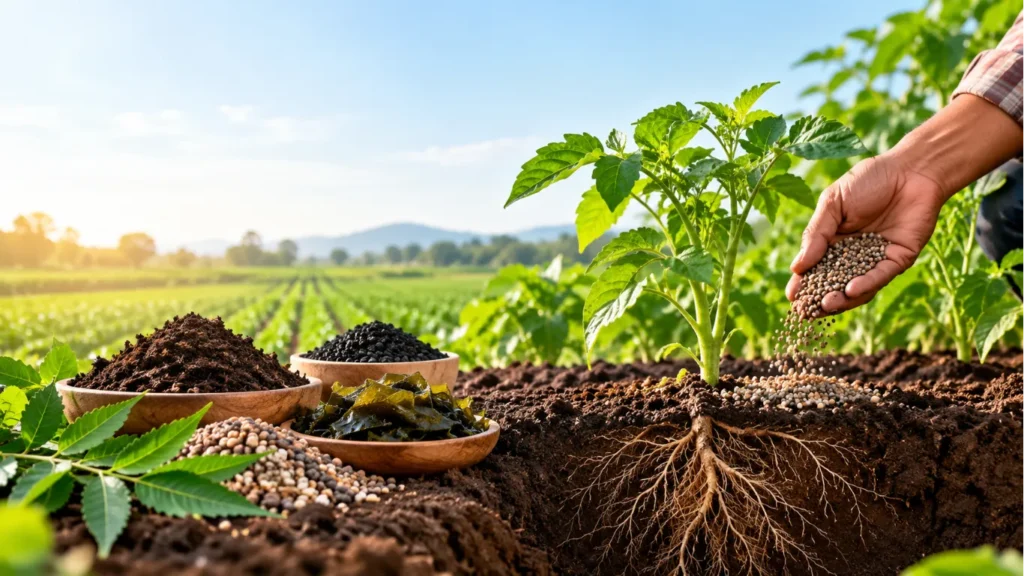
Organic fertilizer has become an important choice for farmers, gardeners, nurseries, and agricultural growers looking for effective ways to support plant growth and maintain healthy soil. Organic fertilizers are derived from natural or organic sources and can provide nutrients while contributing to better soil management.
The right fertilizer depends on several factors, including crop type, soil condition, plant growth stage, nutrient requirements, and application method. Organic fertilizers, biofertilizers, seaweed-based products, neem-based agricultural products, and plant growth promoters can all play different roles in a crop nutrition program.
In this guide, we will explain what organic fertilizer is, its benefits, different types, how to use it, and how to choose the right fertilizer for plants and crops.
1. What Is Organic Fertilizer?
Organic fertilizer is a fertilizer derived from natural or organic sources. Depending on its formulation, it can provide nutrients and organic matter that support plant growth and contribute to healthy soil conditions.
Organic fertilizers may be produced from plant-based materials, animal-derived materials, composted organic matter, naturally occurring minerals, or other organic sources. Their nutrient content and release characteristics can vary according to the ingredients and manufacturing process.
Organic fertilizers are used in home gardens, nurseries, horticulture, commercial agriculture, vegetable production, fruit cultivation, and many other growing environments.
Common applications include:
- Vegetable crops
- Fruit crops
- Flowering plants
- Ornamental plants
- Nursery plants
- Field crops
- Horticultural crops
- Plantation crops
The appropriate fertilizer should always be selected according to the crop and the manufacturer’s recommended application instructions.
2. Benefits of Organic Fertilizer for Plants
Organic fertilizers can provide several benefits when they are selected and applied correctly. One important advantage is that some organic fertilizers contribute organic matter to the soil, which can support soil structure and overall soil management.
Healthy soil provides a favorable environment for plant roots and beneficial microorganisms. Organic inputs can therefore form part of an integrated approach to crop nutrition and soil fertility.
Major benefits of organic fertilizer include:
- Supports plant nutrient requirements
- Can contribute organic matter to soil
- Helps support healthy soil structure
- Can support root development
- Can be included in sustainable crop-management programs
- Suitable formulations are available for different crops
- Can be used in gardens, nurseries, horticulture, and agriculture
However, applying more fertilizer does not necessarily produce better results. The application rate should always be based on the product instructions, crop requirements, and soil conditions.
3. Types of Organic Fertilizers
There are different types of organic and biological agricultural inputs available for plant and crop management. Each product category may have a different purpose.
| Type of Fertilizer | Main Purpose | Common Application |
|---|---|---|
| Organic Fertilizer | Nutrient and organic matter support | Agriculture, gardens, horticulture |
| Biofertilizer | Supports nutrient availability through beneficial microorganisms | Agricultural crops |
| Seaweed Fertilizer | Supports plant growth and crop development | Vegetables, fruits, horticulture |
| Neem-Based Products | Agricultural and plant-care applications | Crops and gardens |
| Plant Growth Promoter | Supports plant growth and development | Various crops |
| Compost-Based Fertilizer | Adds organic matter and nutrients | Gardens and agriculture |
The correct product depends on the crop, soil condition, season, plant growth stage, and specific agricultural objective.
4. Organic Fertilizer vs. Chemical Fertilizer
Organic and synthetic fertilizers can both be used in crop nutrition, but they differ in their sources, compositions, nutrient concentrations, and release characteristics.
Organic fertilizers are generally derived from organic or natural sources, while synthetic fertilizers are manufactured to deliver specific nutrient concentrations.
| Feature | Organic Fertilizer | Synthetic Fertilizer |
|---|---|---|
| Source | Organic or natural sources | Manufactured nutrients |
| Organic matter | Some products can contribute organic matter | Generally does not add organic matter |
| Nutrient release | Depends on formulation and environmental conditions | Often designed for predictable nutrient availability |
| Soil management | Can support soil organic matter | Primarily focused on nutrient supply |
| Application | Depends on product formulation | Depends on nutrient concentration |
| Selection | Crop and soil specific | Crop and soil specific |
Neither category should be selected solely based on the fertilizer label. Soil conditions, crop requirements, nutrient levels, and recommended application practices should be considered before making a fertilizer decision.
5. How to Use Organic Fertilizer
Correct application is essential for using any fertilizer effectively. The recommended quantity and application method can vary significantly depending on the product formulation and crop.
Before applying organic fertilizer, carefully check the product label and follow the manufacturer’s recommended dosage.
Common application methods may include:
- Mixing fertilizer with soil before planting
- Applying fertilizer around the root zone
- Incorporating fertilizer into planting beds
- Applying during specific crop growth stages
- Applying through irrigation when the product permits it
- Using it as part of an integrated crop nutrition program
Avoid using more fertilizer than the recommended quantity. Excessive fertilizer application can be unnecessary and may create nutrient-management problems.
For commercial farming, fertilizer application can be planned using soil-test results, crop nutrient requirements, and recommendations from qualified agricultural professionals.
6. When Is the Best Time to Apply Organic Fertilizer?
The best time to apply organic fertilizer depends on the crop, fertilizer formulation, soil condition, and stage of plant development.
Fertilizer application may be particularly important during plant establishment, active vegetative growth, flowering, fruit development, or other stages when nutrient requirements increase.
Important factors to consider include:
- Crop type
- Plant age
- Soil condition
- Weather conditions
- Growth stage
- Fertilizer formulation
- Irrigation practices
- Recommended application schedule
A fertilizer intended for soil application before planting may have a different application schedule from a liquid plant-growth product.
Therefore, growers should follow the specific product instructions instead of using the same application schedule for every crop.
7. Organic Fertilizer for Different Crops
Different crops have different nutrient requirements. For this reason, fertilizer selection should be based on the specific crop and growing conditions.
Vegetable Crops
Vegetable crops require appropriate nutrition throughout their growth cycle. Suitable organic fertilizers can be included in a crop nutrition program according to soil conditions and crop requirements.
Fruit Crops
Fruit crops have changing nutrient requirements during vegetative growth, flowering, fruit development, and harvesting. Fertilizer programs should be adjusted according to the crop and growth stage.
Flowers and Ornamental Plants
Organic fertilizer can be used for suitable flowering and ornamental plants when the formulation and dosage are appropriate for the plant species.
Field Crops
For commercial field crops, fertilizer selection should consider soil-test results, crop nutrient requirements, expected yield, local growing conditions, and recommended agricultural practices.
8. How to Choose the Right Organic Fertilizer
Choosing an organic fertilizer only because it is labelled “organic” is not enough. The fertilizer should match the requirements of the crop, soil, and intended application.
Before selecting a product, consider the following factors:
- Crop type
- Soil condition
- Nutrient requirements
- Plant growth stage
- Product composition
- Application method
- Recommended dosage
- Compatibility with existing crop-management practices
It is also important to purchase agricultural inputs from a reliable manufacturer or supplier and carefully read the product label before application.
chayanfertilizers provides agricultural input solutions for different crop nutrition and plant-growth requirements. Farmers and growers can explore suitable products based on their specific agricultural needs.
9. Frequently Asked Questions About Organic Fertilizer
What is organic fertilizer?
Organic fertilizer is a fertilizer derived from organic or natural sources. Depending on the formulation, it can provide nutrients and organic matter to support plant growth and soil management.
Is organic fertilizer good for plants?
When selected and applied correctly, organic fertilizer can provide nutrients and contribute to soil management. Its suitability depends on the crop, soil, product formulation, and recommended application rate.
How often should organic fertilizer be applied?
There is no universal application frequency. It depends on the fertilizer formulation, crop, soil condition, plant growth stage, and manufacturer’s recommendations.
Can organic fertilizer be used for vegetables?
Yes. Suitable organic fertilizers can be used for vegetable crops. The product and dosage should be selected according to the crop’s specific nutrient requirements.
What is the difference between organic fertilizer and biofertilizer?
Organic fertilizer generally refers to fertilizer products derived from organic sources. Biofertilizers commonly contain beneficial microorganisms that can support nutrient availability or plant nutrition.
Can organic fertilizer improve soil?
Some organic fertilizers can contribute organic matter and support soil structure and biological activity. The effect depends on the product composition and overall soil-management practices.
Can organic fertilizer be used with other fertilizers?
Depending on the product, organic fertilizer may be included in an integrated nutrient-management program. Product compatibility, dosage, and application timing should be checked before combining different agricultural inputs.
Need Help Choosing the Right Fertilizer?
Selecting the right agricultural input can be challenging because different crops, soils, and growth stages have different requirements.
Chayan Fertilizers offers a range of agricultural products designed for different plant nutrition and crop-management needs.
Whether you are looking for organic fertilizer, biofertilizer, seaweed-based products, neem-based agricultural products, or plant growth promoters, it is important to select the appropriate product and follow the recommended application instructions.
Visit chayanfertilizers to explore agricultural products and learn more about available solutions.
For specific crop requirements, farmers and growers can contact the team for product information and guidance.
Conclusion
Organic fertilizer can be an important part of a balanced crop and soil management program. Depending on its formulation, it can provide nutrients, contribute organic matter, and support favorable growing conditions.
The right approach is to consider the crop, soil condition, growth stage, fertilizer composition, and recommended dosage before application. Proper irrigation, soil management, and crop-care practices should also be considered alongside fertilizer use.
chayanfertilizers provides agricultural input solutions for growers looking for products that support different crop nutrition and plant-care requirements.